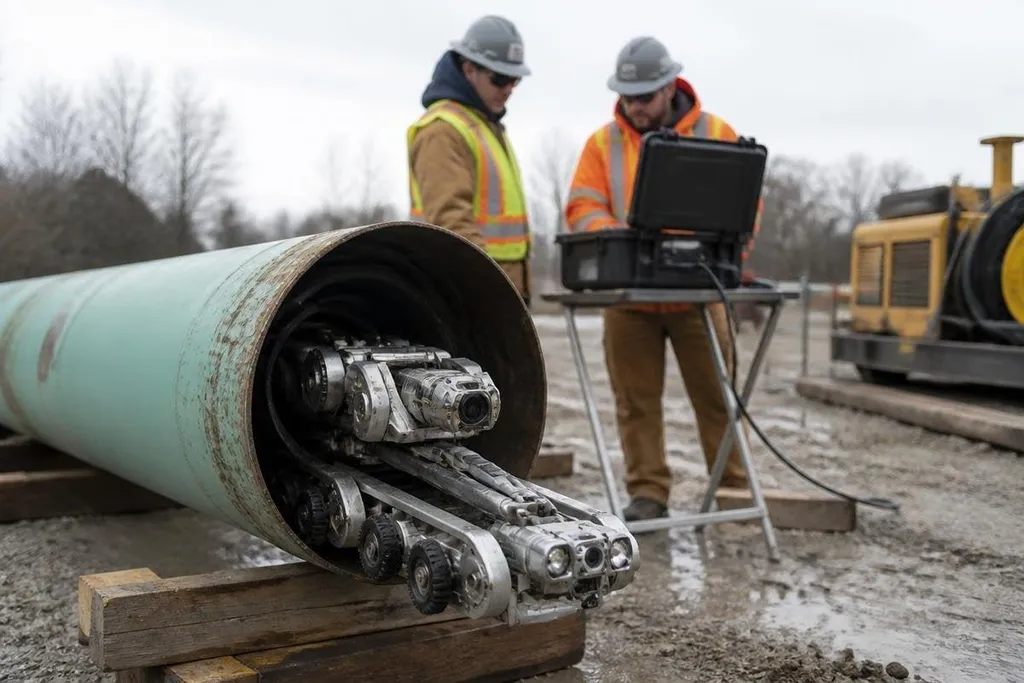
No named robot, field trial, price, or test result sits behind this topic. A fair article can still answer the useful question: what would a better pipeline robot need to do before an operator could trust it?
- Inspection data needs a clear link to a repair decision.
- Pipe access, power, and communications can limit the mission.
- A useful system must show repeatable work outside a controlled demo.
Inspection is the starting point
A pipeline robot may carry cameras, lights, or other sensors through a pipe. That can help an operator find corrosion, cracks, dents, debris, or changes in the pipe wall, but a picture alone doesn't fix the asset.
The next step is turning sensor data into a maintenance action. Its report needs to mark where a fault sits, record its size, and connect that finding to the pipe section under review.
Without that chain, a team still has to spend time finding the same spot by hand. A useful report should also show what the robot couldn't inspect.
A blocked route, poor lighting, weak signal, or dirty lens can leave gaps that matter more than a clean image from an easy section.
A pipeline inspection report needs more than a clean image. Robot24.com robotics coverage can connect the robot’s task, pipe section, test date, and measured result to the field conditions that shaped them. That record leads into repair, where inspection ends and physical work begins.
Repair changes the machine
Inspection and repair place different demands on a robot. A camera platform can move through a pipe with a small body and low power needs. A repair system may need to carry a tool, press against the pipe wall, remove material, apply a patch, or check the result.
Each task adds force, control, and safety problems. It must keep its position while a tool touches the pipe. The system must avoid damaging sound material near the fault, and it needs a way to stop when the tool meets an unexpected obstruction.
A tether can carry power and data, but it may drag on bends or narrow sections. A battery removes that cable, but the robot then has a fixed energy limit. Wireless links can lose strength inside metal pipe, leaving the operator with delayed or missing video.
These limits are not small details. They decide which pipe sections the robot can reach and how much work it can finish before a recovery plan is needed.
Autonomy needs a clear boundary
An autonomous system can handle repeated movement and sensor checks without a person controlling every motor command. That can reduce operator workload, but it doesn't remove the need for human review.
The safe division of work should be plain. The robot can follow a route, collect images, and flag a possible fault. A trained person can confirm the finding, choose a repair method, and stop the system when the pipe or task falls outside its limits.
The hard proof is repeatability. A single successful run says little about performance across bends, deposits, changing pipe sizes, or poor visibility. A serious trial would need records from failed runs as well as successful ones, with the cause of each failure stated.
No purchase decision should rest on a video that omits recovery, signal loss, or the handoff from robot data to maintenance staff. I'd skip any system that shows clean inspection footage but gives no account of missed sections and failed runs.
A practical buying check
Before a pipeline operator approves a pilot, ask for these records:
- Route limits: list the pipe sizes, bends, slopes, valves, and surface conditions the robot can handle.
- Mission record: show run time, distance, speed, power use, and the reason for every stop.
- Fault record: state which defects the sensors can find and which ones they can miss.
- Repair proof: show the tool, contact force, repair material, and inspection used after the work.
- Recovery plan: explain how staff retrieve the robot after a motor fault, blocked route, or lost link.
- Data handoff: show how findings reach the maintenance system with location and image records attached.
This list separates a robot that collects pictures from one that can fit a real maintenance process. It also gives the operator a way to compare a small pilot with a larger rollout without accepting broad claims.
The next useful pipeline robot will earn its place through repeatable inspection, clear limits, and repair records that another engineer can check. Until a named system publishes those results, the right question is not how advanced the robot sounds, but what work it can finish and prove.